 listicle
Engaging Activity Ideas for Toddlers: 25+ Fun Picks
Table of Contents
- Why Play-Based Toddler Activity Ideas Matter for Development
- Learning Activities for Toddlers: Building Skills Through Play
- Sensory Activities for Toddlers: Touch, Sound, and Exploration
- Indoor Activities for Toddlers: Rainy Day and Small Space Ideas
- Toddler Activities That Are Not Crafts: Movement and Pretend Play
- Matching Activities to Your Toddler's Age and Stage
- Safety, Supervision, and Inclusive Adaptations
- Conclusion: Making Engaging Activity Ideas Work for Your Family
- Frequently Asked Questions
Last Updated: October 16, 2026
Why Play-Based Toddler Activity Ideas Matter for Development
Engaging activity ideas for toddlers work best when they follow one simple rule: children learn by doing, not by watching. A toddler stacking blocks, scooping rice, or chasing bubbles is building the exact neural pathways that support language, motor control, and problem-solving later on. Childcare Etc Irvine focuses on offering a nurturing environment for children, and play is how young children do their most important work.
This guide collects more than 25 engaging activity ideas for toddlers, sorted by the skills they build and matched to ages 1 through 3. Most need nothing more than what's already in your kitchen cupboard.
Learning Activities for Toddlers: Building Skills Through Play
Learning activities for toddlers should feel like games, not lessons. When a child sorts colored socks into piles, they're practicing classification, the same thinking skill that later supports reading and math. Keep sessions short and follow your child's lead.
Counting and Sorting Games
Try these three setups, each taking under five minutes to prepare:
- Snack sorting: Give your toddler a bowl of large cereal pieces and two muffin cups. Ask them to put "big ones here, small ones there." This builds comparison skills and pincer grasp.
- Stair counting: Count each step out loud as you climb together. Toddlers absorb number order long before they can count independently.
- Laundry basket toss: Sort socks by color into separate baskets. Name each color as it lands.
Storytime and Language Building
Reading books with your toddler does more for language than any flashcard set. Point to pictures, pause for your child to fill in familiar words, and ask simple questions like "Where's the dog?" Singing the same songs repeatedly helps too, since repetition is how toddlers lock in new vocabulary.
Sensory Activities for Toddlers: Touch, Sound, and Exploration
Sensory activities for toddlers give children safe ways to explore texture, temperature, and sound. These experiences calm nervous systems and build focus, which is why they're a staple in early childhood classrooms.
Sensory Bins and Texture Play
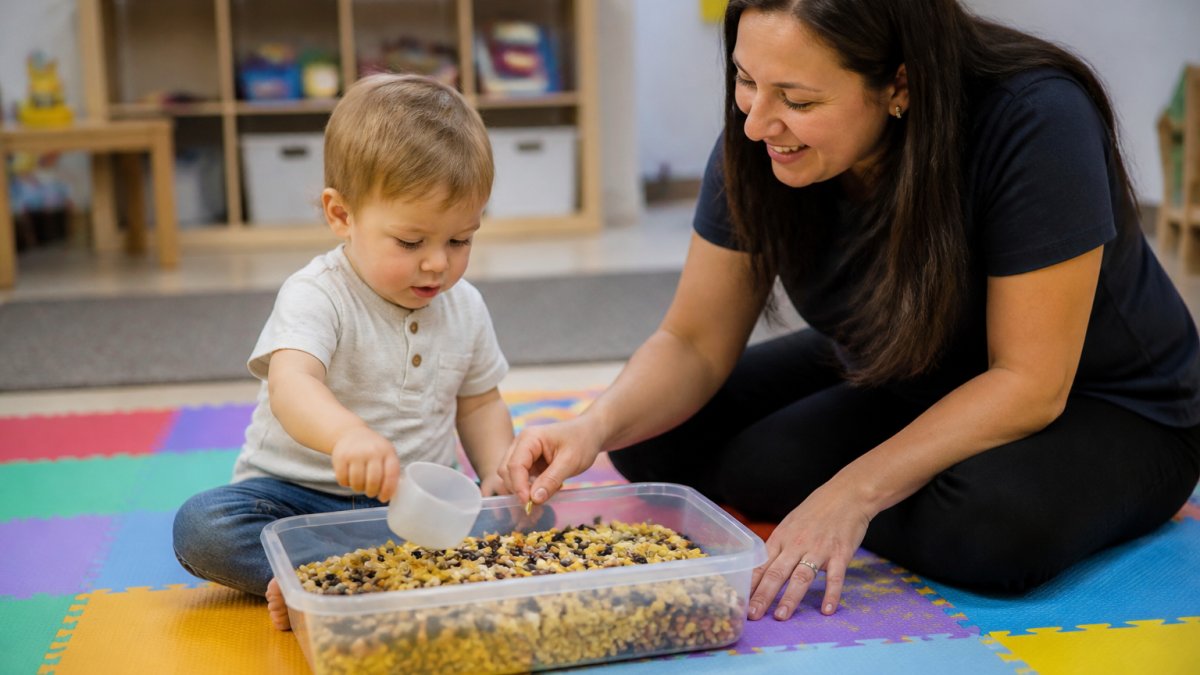
A sensory bin is a shallow container filled with a safe material your toddler can scoop, pour, and dig through. Dried rice, large pasta shapes, water beads, and kinetic sand all work well. Add measuring cups and spoons, then let your child lead.
Music, Rhythm, and Homemade Instruments
Fill plastic eggs with rice and tape them shut for instant shakers. A sturdy box and two wooden spoons become a drum. Clapping games, freeze dance, and singing rounds build rhythm awareness and gross motor skills at the same time. These homemade instruments cost nothing and toddlers return to them for months.
Indoor Activities for Toddlers: Rainy Day and Small Space Ideas
Indoor activities for toddlers need to burn energy without wrecking the living room. When weather or space keeps you inside, these standbys work in almost any apartment or house:
- Cushion obstacle course: Line up pillows to crawl over, under, and around.
- Tape line walking: Lay painter's tape in a straight or zigzag line and have your child walk it like a balance beam.
- Balloon keepy-uppy: Tap a balloon back and forth to build hand-eye coordination.
According to Zero to Three's guidance on play and development, movement-based play during the early years directly supports both physical coordination and emotional regulation.
Toddler Activities That Are Not Crafts: Movement and Pretend Play
Toddler activities that are not crafts matter just as much as art projects, especially for children who dislike sitting still. Movement and pretend play develop gross motor skills, social skills, and imagination without a single glue stick.
Animal Rescue and Pretend Play Games
Set up an "animal rescue" by taping toy animals to a low table and giving your toddler a mission to free them. Pretend play like this builds problem-solving and language as children narrate what's happening.
Head Start's early learning outcomes framework describes pretend play and interactive games as core building blocks for school readiness.
Matching Activities to Your Toddler's Age and Stage
Age-appropriate play looks different at 12 months than at 3 years, and the difference is not just size or speed. It tracks the developmental milestones toddlers hit in sequence: object permanence, then cause-and-effect, then symbolic thinking, then turn-taking.
Use the table below as a starting point, then read the notes underneath it for how to adapt each band up or down.
| Age band | What's developing | Best activity types | Example | Typical duration | Supervision level |
|---|---|---|---|---|---|
| 12-18 months | Object permanence, cause-and-effect, pincer grasp emerging | Sensory bins, stacking, music, peekaboo | Dried pasta scooping; nesting cups | 5-10 minutes, 2-3 times a day | Constant, within arm's reach |
| 18-24 months | Classification, early pretend play, two-word phrases | Sorting, simple pretend play, scribbling | Color sorting cups; feeding a stuffed animal | 10-15 minutes | Constant, close by |
| 2-3 years | Symbolic thinking, short narratives, gross motor confidence | Storytime, counting games, movement, simple crafts | Stair counting; freeze dance; chunky crayon drawing | 15-20 minutes | Active, within sight |
| 3+ years | Turn-taking, rule-following, cooperative play | Puppet shows, board games, group pretend play | Animal rescue; simple card games | 20-30 minutes | Nearby, checking in |
How to Adapt an Activity Up or Down
A toddler who is not yet walking can still do most sensory and sorting activities from a seated position, put the bin on a low tray table or on the floor between your legs.
A common pattern practitioners use is the "one small stretch" rule: pick an activity your child can already do, then change exactly one variable, a new texture, a new color, a slightly smaller scoop.
A Repeatable Activity Template
For each idea in this guide, you can fill in the same five blanks before you start. This makes the list scannable and stops the "what do we do now?" pause that ends most play sessions early.
- Materials: what you need, ideally already in the house
- Setup time: how long before your child can start
- Duration: a realistic window before attention fades
Signs It's Time to Move Up a Band
You do not need a formal assessment. Watch for three signals: your child finishes the activity and looks for more, your child starts improvising a new rule, or your child starts narrating what they are doing. Any of those means the current version has become too easy and a small stretch will re-engage them.
Safety, Supervision, and Inclusive Adaptations
Safety comes first with every activity on this list, and the specifics matter more than the general rule. The two hazards that send toddlers to the emergency room most often during play are choking and falls, and both are almost entirely preventable with a few checks before you start.
Choking Hazards to Check Before Every Activity
A useful rule of thumb is the toilet-paper-tube test: if an object fits entirely inside a cardboard tube, it is small enough to be a choking risk for a child under 3. That includes water beads, which look harmless but expand in moisture and have caused serious injuries. Round foods like whole grapes, popcorn, and hard candy are also common choking hazards and should be cut lengthwise or avoided entirely for this age group.
Before any sensory bin, do a quick pass:
- Nothing smaller than a quarter in any dimension
- No balloons, including uninflated ones
- No magnets or button batteries, ever
Supervision Levels That Actually Match the Activity
"Supervised" is not a single setting. Match your attention to the risk:
- Within arm's reach: water play, anything with small parts, anything involving climbing
- Within sight and earshot: crafts, sorting, pretend play on the floor
- Nearby, checking in: independent play with large, safe materials in a childproofed space
Water safety deserves its own note. A toddler can drown in as little as two inches of water, so a shallow bin still requires a hand on the child at all times (Drowning Prevention for Curious Toddlers: What Parents Need to Know). Never leave a toddler alone with water, even for a moment, even to grab a towel.
Non-Toxic Materials and What to Look For
For anything that goes in or near the mouth, look for the "AP" (Approved Product) seal from the Art & Creative Materials Institute on art supplies, and choose paints and markers labeled non-toxic and washable. Avoid anything labeled with a hazard warning, and skip homemade play dough recipes that call for raw flour, which can carry bacteria.
Inclusive Adaptations for Different Abilities and Sensory Needs
Every toddler engages differently, and the goal of an inclusive activity is to remove the barrier without removing the challenge. A few concrete swaps that work across the activities in this guide:
- Tactile sensitivity: offer tools instead of bare hands, scoops, tongs, paintbrushes, or a spoon, so the child can participate without direct contact with the texture
- Auditory sensitivity: offer noise-reducing headphones during music and movement activities, or swap a loud instrument for a soft one like a felt drum
- Mobility differences: move the activity to a tray table, floor mat, or seated position; for a child using a wheelchair or walker, tape the sensory bin to the tray so it does not slide
A Quick Pre-Play Safety Checklist
Run through these five questions before you set anything down:
- Is anything in this activity small enough to fit in a toilet-paper tube?
- Is there water, and is my hand on my child?
- Are the materials non-toxic and labeled for children?
- Is there a clear path if my child bolts or falls?
- Do I have a cleanup plan that does not leave small parts on the floor?
Conclusion: Making Engaging Activity Ideas Work for Your Family
Finding engaging activity ideas for toddlers doesn't require expensive toys or hours of prep. A few household materials, ten focused minutes, and your full attention are enough to turn an ordinary afternoon into real learning. If you're balancing work and family and want a partner who supports early development, Childcare Etc Irvine offers a nurturing, play-based environment.
Frequently Asked Questions
What are some learning activities for toddlers?
Learning activities for toddlers blend play with skill-building. Try counting games with blocks or snacks, sorting by color or shape, and simple puzzles. Storytime builds vocabulary, while singing songs with hand motions supports memory and language. For ages 1-3, keep sessions short, around 5-10 minutes, and follow your child's interest. Hands-on games that let toddlers touch, move, and repeat actions work best because play-based learning is how young children absorb new concepts without formal instruction.
How can I keep a toddler engaged in an activity?
Toddlers engage when activities match their energy and curiosity. Rotate materials every few minutes, sit at their level, and narrate what they are doing. Offer choices like two different sensory bins or two books. Movement breaks, songs, and clapping games reset attention. If your child loses interest, follow their lead rather than forcing the activity. Short, simple activities repeated often usually hold attention better than long, complex setups, and independent play options let toddlers explore at their own pace.
What are some toddler activity ideas that are not crafts?
Plenty of engaging toddler activity ideas skip glue and paint entirely. Try freeze dance, obstacle courses with pillows, pretend play like a puppet show, or an animal rescue game where toy animals are freed from a tape web. Sensory bins with rice or water, singing with homemade instruments, and indoor scavenger hunts all build fine motor and gross motor skills without any craft supplies. These options suit busy parents who want low-prep, low-mess play that still supports development.
How do toddler activities support early learning?
Play-based learning builds the foundation for school readiness. Sensory play strengthens fine motor skills and hand-eye coordination. Sorting and counting games introduce early math. Storytime and singing expand vocabulary and listening skills. Turn-taking games teach social skills and patience. Research consistently links hands-on play in ages 1-3 to stronger language, problem-solving, and creativity later on. In a nurturing daycare setting, these activities can support each child's developmental stage.